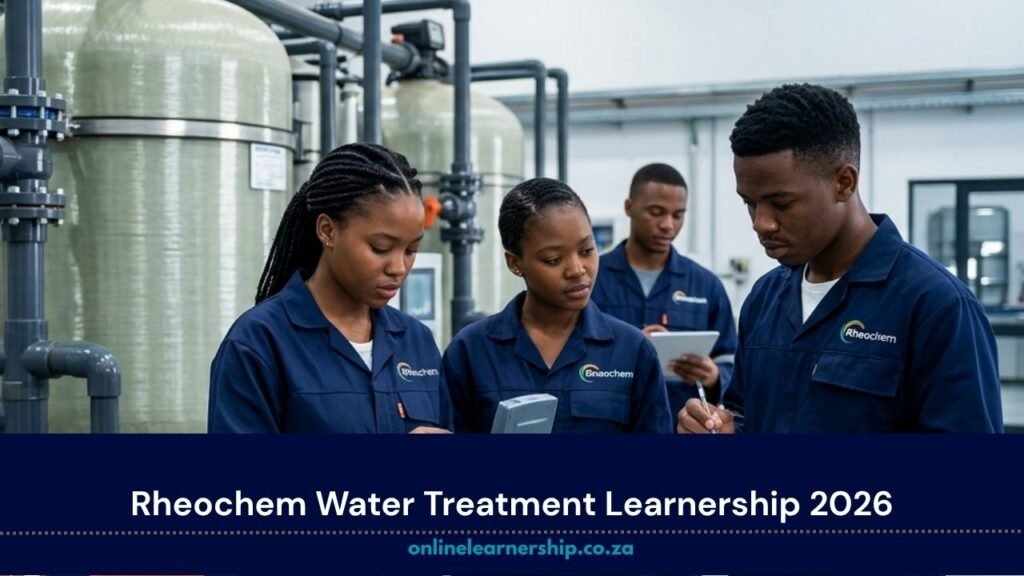
Rheochem Water Treatment Learnership 2026: Earn Up to R12,000 Per Month
The Rheochem Water Treatment Learnership 2026 presents an opportunity for suitably qualified graduates to gain practical experience in the water-treatment industry while receiving advertised remuneration of R10,000 to R12,000 per month.
The 12-month programme is aimed at graduates in fields such as Chemistry and Chemical Technology, with candidates at the beginning of their careers encouraged to apply. Applicants with up to one year of experience may also be considered.
For graduates who have completed years of university study but are struggling to secure their first technical opportunity, the programme could provide valuable exposure to workplace processes, technical procedures and industrial water-treatment systems.
Rheochem Water Treatment Learnership 2026 Overview
The Rheochem Water Treatment Learnership 2026 is structured as a 12-month fixed-term programme combining workplace responsibilities, structured learning and practical experience.
Rather than being limited to classroom-based training, participants are expected to gain exposure to real workplace activities. This can help graduates understand how scientific and engineering principles are applied in industrial water-treatment environments.
The opportunity is particularly relevant to graduates interested in water treatment, chemistry, chemical processes, environmental services and industrial operations.
Key details include:
- Programme: Water Treatment Learnership
- Organisation: Rheochem
- Duration: 12 months
- Advertised remuneration: R10,000–R12,000 per month
- Target applicants: Recent graduates
- Relevant fields: Chemistry and Chemical Technology
- Experience: Candidates with up to one year of experience may be considered
- Location linked to the opportunity: Pinetown, Westmead
- Potential relocation: Successful applicants may need to relocate to eMalahleni
- Application method: Online
- Closing date: No specific closing date is indicated on the current listing
Who Can Apply for the Rheochem Water Treatment Learnership 2026?
The programme is intended for graduates with relevant qualifications, particularly those who have completed a degree in Chemistry or Chemical Technology.
Applicants should carefully check the official recruitment requirements before submitting an application. A Matric certificate or unrelated qualification should not be assumed to meet the graduate-level requirement.
The opportunity may be particularly relevant to graduates who need practical workplace exposure after completing their studies.
Candidates with limited professional experience should not automatically assume they are unsuitable. Relevant university and practical experience can help demonstrate technical ability.
This could include:
- University laboratory work
- Final-year projects
- Research projects
- Vacation work
- Internships
- Laboratory-assistant experience
- Engineering-related applications
- Other relevant industry exposure
Is Work Experience Required?
Extensive professional experience is not indicated as a requirement. Candidates with up to one year of experience may be considered.
For graduates without permanent employment history, relevant academic work can still demonstrate useful abilities. A CV should therefore clearly explain practical projects, laboratory exposure, research and internships where applicable.
Applicants should always provide accurate information and avoid claiming experience they do not have.
What Skills Are Useful for the Rheochem Water Treatment Learnership?
Water-treatment work requires technical accuracy, logical thinking and the ability to follow established procedures.
Useful skills and qualities may include:
- Scientific and engineering aptitude
- Problem-solving
- Attention to detail
- Written communication
- Verbal communication
- Teamwork
- Ability to work independently
- Following technical instructions
- Accuracy
- Ability to understand technical procedures
Water-treatment environments can require careful monitoring and communication. Graduates may therefore benefit from demonstrating both their academic knowledge and their ability to apply that knowledge responsibly.
What Does Water Treatment Involve?
Water treatment uses physical, chemical and technical processes to improve water quality for a particular purpose.
Depending on the application, processes can include:
- Chemical dosing
- Filtration
- Coagulation
- Flocculation
- pH control
- Disinfection
- Reverse osmosis
- Wastewater treatment
- Boiler-water treatment
- Cooling-water treatment
- Water-quality testing
Industrial water treatment can also support equipment protection, contamination control and reliable industrial processes.
This creates a direct connection between university subjects and practical workplace responsibilities.
Why Chemistry Graduates May Benefit
Chemistry graduates can bring knowledge of chemical reactions, concentrations, pH, analytical testing, contamination, solution chemistry and chemical dosing.
A practical water-treatment programme can allow graduates to see how these concepts operate outside the classroom.
Laboratory experience may also be relevant because water-treatment operations can involve testing, monitoring and analysing water quality.
Graduates should highlight relevant laboratory methods, research projects and technical coursework rather than filling their CV with unrelated academic information.
Why Chemical Engineering Graduates May Benefit
Chemical engineering graduates may have studied areas such as process engineering, fluid mechanics, thermodynamics, process control, mass transfer, heat transfer, plant operations and mass-and-energy balances.
Water-treatment systems can involve several of these principles.
The workplace component of the programme can therefore expose graduates to how engineering concepts operate within real industrial systems, where procedures, efficiency, safety and technical decision-making are important.
What Could Learners Do During the Programme?
Exact duties can depend on operational requirements, but participants should expect a combination of workplace responsibilities and structured learning.
Potential activities may include:
- Following technical procedures
- Observing water-treatment processes
- Working alongside experienced employees
- Learning about treatment systems
- Communicating technical information
- Completing educational activities
- Supporting practical problem-solving
- Developing workplace skills
Participants should approach the programme as professional technical training rather than simply a 12-month observation period.
How Much Does the Rheochem Water Treatment Learnership Pay?
The advertised remuneration is R10,000 to R12,000 per month.
Applicants should understand that this is a salary range. The maximum amount of R12,000 should not automatically be interpreted as the guaranteed payment for every successful candidate.
Final remuneration should be confirmed through the recruitment process and official employment documentation.
The available information also does not clearly advertise additional benefits such as accommodation, transport assistance, meals, relocation support or medical benefits. Applicants should therefore avoid assuming that these benefits are included.
Where Is the Rheochem Water Treatment Learnership Based?
The opportunity is linked to Pinetown, Westmead, but applicants should pay close attention to the potential requirement to relocate to eMalahleni.
Relocation could affect accommodation, transport, food, living expenses and family responsibilities.
Before applying, candidates should consider whether they can realistically relocate if selected.
Itumeleng’s Insider Tip
Prepare a simple monthly budget before applying. Compare the advertised R10,000–R12,000 monthly remuneration with potential rent, transport, food and other relocation expenses.
A technical opportunity can provide valuable experience, but applicants should also make sure that participation is financially practical for their circumstances.
Does the Programme Lead to a Qualification?
The available recruitment information does not clearly specify a particular National Qualifications Framework level, qualification title, SAQA identification number, training provider or SETA-linked qualification.
Applicants should therefore not assume that completing the programme automatically results in a specific formal qualification.
Anyone for whom formal certification is important should confirm these details directly during recruitment.
Does the Learnership Guarantee Permanent Employment?
Permanent employment after the 12-month programme is not guaranteed.
Applicants should primarily view the opportunity as a way to develop practical workplace exposure, water-treatment knowledge, technical skills and problem-solving experience.
The experience gained during the programme may subsequently be included in applications for other technical and graduate positions.
How to Prepare Your CV
Chemistry graduates should make their qualification immediately visible on the CV. Relevant modules, laboratory experience, research projects and technical methods can be highlighted where applicable.
Chemical Engineering graduates can emphasise process design, process control, fluid mechanics, heat transfer, mass transfer, plant operations, engineering projects and safety-related work.
A graduate CV should generally contain:
- Full name and contact details
- Professional profile
- University qualification
- Academic achievements
- Relevant modules
- Technical skills
- Laboratory experience
- Final-year project
- Research experience
- Internship or vacation work
- Computer skills
- Other relevant experience
Keep the document easy to scan and make sure the relevant qualification is immediately clear to the recruiter.
Common Application Mistakes to Avoid
Applicants should avoid:
- Applying without the required qualification
- Providing incorrect contact information
- Submitting an outdated CV
- Hiding important qualification details
- Claiming experience they do not have
- Ignoring the potential relocation requirement
- Assuming R12,000 is guaranteed
- Assuming permanent employment is guaranteed
- Waiting unnecessarily to submit an application
Accuracy is more important than making an application appear stronger than it actually is.
How to Apply for the Rheochem Water Treatment Learnership 2026
Applications are submitted online through the official application process.
The current recruitment information does not indicate a specific closing date. Eligible graduates should therefore avoid waiting for an unofficial deadline and should prepare their documents before submitting.
Applicants should carefully check the official listing for the latest requirements and application instructions before completing their submission.
Before Applying, Make Sure You
- Update your CV.
- Ensure your contact details are correct.
- Upload clear certified documents if requested.
- Double-check your academic information.
- Apply well before the closing date.
- Keep copies of your application confirmation.
- Submitting an incomplete application may reduce your chances of being shortlisted.
DISCOVER MORE:
- APPRENTICESHIP
- GRADUATE PROGRAMME 2026
- INTERNSHIP 2026
- Learnerships 2026
- Learning Program 2026
- ONLINE APPLICATION
- ONLINE COURSES
- PROGRAMME 2026
- SETA
- Training Programme
onlinelearnership Advice
If you qualify for this opportunity, do not wait until the final day to apply. Recruitment systems can experience heavy traffic close to closing dates, and last-minute technical problems could prevent an application from being submitted successfully.
Before applying, make sure your CV is updated, your academic records are ready, and your proof of residence is available where required.
If you are completing your qualification and need workplace exposure to graduate, opportunities such as this can potentially provide practical experience that strengthens your future employment applications.
Also continue applying for similar internships and Work-Integrated Learning opportunities instead of relying on a single application.
Frequently Asked Questions
How much does the Rheochem Water Treatment Learnership pay?
The advertised remuneration is R10,000 to R12,000 per month. The final amount should be confirmed during the recruitment process.
How long is the Rheochem Water Treatment Learnership?
The programme is advertised as a 12-month fixed-term opportunity.
Which qualifications are required?
The opportunity is aimed at graduates, particularly those with qualifications in Chemistry or Chemical Technology. Applicants should confirm the official requirements before applying.
Is previous work experience required?
Candidates with up to one year of experience may be considered. Relevant university projects, laboratory work, internships and research can also help demonstrate practical ability.
Will Rheochem provide permanent employment after the programme?
Permanent employment is not guaranteed after completion of the 12-month programme.
Could successful applicants need to relocate?
Yes. The opportunity is linked to Pinetown, Westmead, while successful applicants may need to relocate to eMalahleni. Candidates should consider the financial and personal implications before applying.
Is there a confirmed closing date?
The current recruitment information does not specify a particular closing date. Applicants should check the official listing for the latest status before submitting.
Grow Your Career with SETACareers
Access the latest learnerships, internships, bursaries, scholarships, fellowships, apprenticeships and practical SETA guides designed to help you prepare for career opportunities.
Final Thoughts
The Rheochem Water Treatment Learnership 2026 offers eligible Chemistry and Chemical Technology graduates an opportunity to gain practical exposure in water treatment over a 12-month period.
The advertised remuneration is R10,000–R12,000 per month, but applicants should remember that the salary range, additional benefits and permanent employment are not guaranteed.
The potential relocation requirement should also be considered carefully before applying.
Graduates who meet the requirements should prepare an accurate CV, gather their supporting documents and submit their applications while recruitment remains open. At the same time, continuing to apply for other internships, learnerships and Work-Integrated Learning opportunities can help broaden their chances of gaining valuable workplace experience.

OnlineLearnership.co.za Editorial Team is dedicated to helping South Africans discover genuine career opportunities and build successful futures. Our team researches, verifies, and publishes the latest learnerships, internships, apprenticeships, graduate programmes, bursaries, entry-level jobs, and career development resources from trusted employers, government departments, municipalities, SETAs, TVET colleges, universities, and private companies across South Africa.
Our mission is to make career information easy to access by providing accurate, up-to-date, and easy-to-understand content that empowers job seekers, stude