
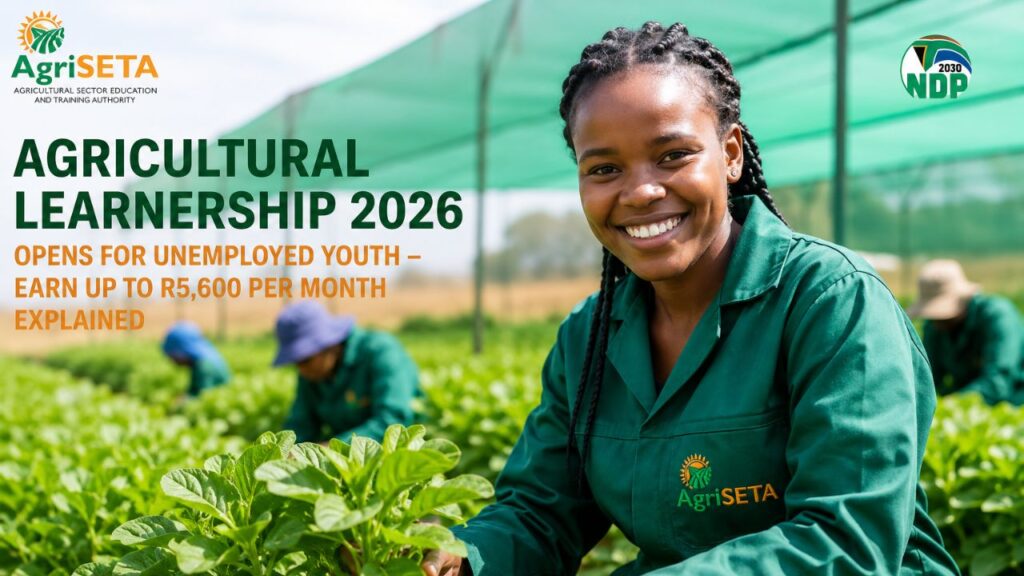
South Africa’s farming sector is addressing youth unemployment through the rollout of the Agricultural Learnership 2026. This comprehensive 12-month program provides structural workplace learning and a reliable monthly stipend of up to R5,600. Eligible youth holding qualifications from Grade 9 through to Matric can access hands-on training across multiple provinces. Discover the steps required to submit a successful application today.
Quick Information Box
| Detail | Specifications |
|---|---|
| Programme Name | Agricultural Learnership Programme 2026 |
| Employer / Host Entity | South African Sugar Association (SASA) & Partner Agriculture Hosting Firms |
| Location | Western Cape, KwaZulu-Natal, Limpopo, and Gauteng |
| Duration | 12 Months (Full-Time) |
| Monthly Stipend/Salary | Up to R5,600 per month |
| Closing Date | Open enrollment ongoing / Check institutional notices |
| Reference Number | AGRI-LEARN-2026 |
| Application Method | Postal Delivery, Physical Drop-Off, or Official Institutional Channels |
Introduction
Securing a sustainable career path in South Africa’s modern economy requires a strategic mix of technical knowledge and verified field experience. The newly announced Agricultural Learnership 2026 provides an exceptional entry point for young, unemployed South Africans looking to build a career in agribusiness. Supported by key industry entities including the South African Sugar Association (SASA), this year-long program addresses the nationwide skills deficit by paying young learners while they obtain a structured qualification.
Operating across major economic hubs—including the Western Cape, KwaZulu-Natal, Limpopo, and Gauteng—this initiative combines classroom-based conceptual studies with foundational field placements. Successful applicants will earn a monthly stipend of up to R5,600, mitigating the financial burdens often associated with entry-level skills acquisition. If you are an energetic, practical individual eager to contribute to national food security, local rural development, and advanced agricultural logistics, this program offers the structure you need. Below is a comprehensive breakdown of how to prepare your documents and submit a competitive application.
Agricultural Learnership 2026 Programme Overview
The strategic framework of the Agricultural Learnership 2026 is built on a dual-system education methodology. Unlike purely academic courses, a registered learnership blends institutional instruction with active operational experience. This ensures that when a learner graduates, they possess a strong understanding of industrial agricultural practices alongside real-world problem-solving capabilities.
The core purpose of this program is to build a skilled pipeline of operational talent to support South Africa’s vital agricultural export markets and domestic food supply chains. By partnering with accredited sector education bodies, the program transforms raw talent into competent technicians, farm supervisors, and agribusiness operators. For youth who have felt excluded from traditional tertiary education due to financial constraints or high entry requirements, this funded learnership provides a debt-free pathway to a recognized qualification.
Agricultural Learnership 2026 Available Opportunities
The 2026 recruitment drive covers a variety of operational roles designed to expose candidates to different aspects of modern farming. Participants are placed in specific streams based on regional requirements and local farm allocations:
- Crop Production Streams: Focused on specialized soil management, open-field cultivation, and pre-harvest crop care.
- Livestock Care and Management: Operational training covering animal welfare, automated feeding systems, and bio-security protocols.
- Irrigation and Infrastructure Units: Specialized technical roles looking at water conservation systems, automated pumping setups, and resource management.
- Farm Machinery and Fleet Operations: Hands-on training in handling modern farming implements, mechanical maintenance, and smart farming technologies.
- Agribusiness and Logistics Support: Administrative positions based at central packhouses, tracking distribution metrics, inventory levels, and quality control.
Agricultural Learnership 2026 Minimum Requirements
To ensure a fair and standardized selection process, applicants must satisfy several baseline requirements. Review these criteria carefully to confirm your eligibility before starting the application process.
Educational Requirements
The program accommodates multiple educational levels, making it accessible to a wide range of young people. The minimum qualification standard is:
- An official Grade 9, Grade 10, Grade 11, or National Senior Certificate (Grade 12).
- No prior specialized agricultural qualification is required; a positive attitude and a basic command of English are sufficient.
Age Requirements
- Applicants must be 18 years of age or older at the time of application submission.
- While targeted primarily at historical youth demographics to combat structural unemployment, there is no strict upper-age limit, provided the candidate meets the physical health requirements necessary for farm operations.
Additional Requirements
To complete the standard operational vetting process, you must satisfy the following:
- Citizenship: Valid South African citizenship with an authentic green barcoded Identity Document or smart ID card.
- Employment Status: Applicants must be currently unemployed and not registered in any other active learnership or formal academic program.
- Location/Residency: Preference is often given to applicants who reside within proximity of the hosting farms or research stations in the Western Cape, KwaZulu-Natal, Limpopo, or Gauteng.
- Driver’s Licence: While not compulsory for all streams, holding a valid Code 8 (B) or Code 10 (C1) licence is advantageous for machine and fleet roles.
Agricultural Learnership 2026 Monthly Stipend and Benefits
Participating in the Agricultural Learnership 2026 offers strong financial and professional foundations designed to support sustainable career growth.
Direct Financial Compensation
- Stipend: Learners receive a monthly financial stipend of up to R5,600. This structured allowance ensures that participants can sustain themselves throughout the 12-month contract without worrying about basic living costs.
Workplace Training Benefits
- Accredited Certification: Upon successful completion of all theoretical modules and practical workplace evaluations, candidates earn a nationally recognized qualification.
- Practical Mentorship: Work daily alongside seasoned farm managers, agronomists, and machinery technicians who provide real-world insights.
- Transferable Soft Skills: Develop key professional competencies, including team communication, time management, workplace safety compliance, and proactive problem-solving.
Why This Agricultural Learnership 2026 Opportunity Matters for South African Youth
Agriculture remains a resilient and vital part of South Africa’s economy. As global supply chains change and smart agricultural technologies evolve, the demand for skilled, technically capable workers is at an all-time high. This learnership helps bridge the gap between structural unemployment and stable career paths.
Beyond individual benefits, the program strengthens national food security and stimulates rural economies. It transforms farming from an informal sector into an attractive career choice for tech-savvy, forward-thinking young professionals.
Agricultural Learnership 2026 Application Process
Submitting a thorough and compliant application package is key to progressing through the screening process.
Documents Required
Ensure that you have neat, clear copies of the following documents ready:
- Updated, professional Curriculum Vitae (CV).
- Certified copy of your South African Identity Document (certification must be recent, typically within 3 months).
- Certified copies of your highest academic records (Grade 9 report through to Matric certificate).
- Proof of residence (such as a municipal bill or a signed letter from a traditional council/ward councillor).
Important Dates
- Opening Date: Applications for the 2026 cohort are actively being processed.
- Closing Date: Check institutional updates regularly. Candidates are strongly encouraged to submit their materials early to avoid processing delays.
Step-by-Step Application Guide
Follow these steps to submit your application to the South African Sugar Association (SASA) or participating regional offices:
- Step 1: Update your CV to highlight any relevant outdoor work, community projects, or volunteer experience.
- Step 2: Gather and certify all required supporting documents at a South African Police Service (SAPS) station or Post Office.
- Step 3: Draft a brief, professional cover letter indicating the reference number: AGRI-LEARN-2026.
- Step 4: Package your application securely for hand-delivery or postal submission using the address details below:
Physical Address for Hand-Delivery: South African Sugar Association (Head Office) KwaShukela 170 Flanders Drive, Mount Edgecombe, 4300
Postal Address: PO Box 700 Mount Edgecombe, 4300
Application Tips: Agricultural Learnership 2026
- Apply Early: Do not delay your submission. Processing volumes are typically high, and early applications stand out.
- Verify Contact Details: Ensure your mobile number and email address are clearly visible at the top of your CV so recruitment teams can reach you easily.
- Highlight Fit: Mention a genuine interest in agricultural development or food production systems in your cover letter.
DISCOVER MORE:
- APPRENTICESHIP
- GRADUATE PROGRAMME 2026
- INTERNSHIP 2026
- Learnerships 2026
- Learning Program 2026
- ONLINE APPLICATION
- ONLINE COURSES
- PROGRAMME 2026
- SETA
- Training Programme
Common Mistakes Applicants Should Avoid
Many qualified candidates miss out on interviews due to simple errors during the application phase. Avoid these common pitfalls to keep your application competitive:
- Submitting Uncertified Documents: Sending through identity or academic copies without a valid, visible certification stamp can lead to immediate disqualification.
- Illegible Contact Details: If a recruitment officer cannot read your phone number, they cannot invite you to an assessment. Double-check all text for clarity.
- Mismatched Reference Numbers: Failing to clearly state AGRI-LEARN-2026 on your envelope or cover letter can cause your application to be misrouted.
- Waiting Until the Final Deadline: High application volumes can cause administrative backlogs. Submit your materials as soon as they are ready.
Final Thoughts
The Agricultural Learnership 2026 is an excellent opportunity for motivated young South Africans to build a stable, long-term career. By combining funded training, practical experience, and a steady monthly stipend of up to R5,600, this program helps you transition smoothly from unemployment into a vital, growing industry. Organize your documents, double-check your application, and apply early to kickstart your career in agriculture.
Frequently Asked Questions (FAQ)
Who can apply for the Agricultural Learnership 2026?
Unemployed South African citizens who are 18 years of age or older and hold a minimum qualification of Grade 9, 10, 11, or 12 can apply.
What academic qualifications are required?
The programme accepts candidates who have completed Grade 9, Grade 10, Grade 11, or Grade 12 (Matric). No previous diplomas or degrees in farming are necessary.
What documents do I need to submit?
You must submit an updated CV, a certified copy of your South African ID, certified copies of your school reports or certificates, and valid proof of residence.
Is there an age restriction for this Agricultural Learnership 2026 programme?
Applicants must be at least 18 years old. While the initiative targets unemployed youth, all applications that meet the baseline requirements are evaluated fairly.
Is previous farming experience required to be accepted?
No. This learnership is explicitly designed as an entry-level platform to teach foundational skills to beginners.
Is the Agricultural Learnership 2026 a paid opportunity?
Yes. It is a funded, contractual initiative that pays learners a stipend while they complete their training.
How much is the monthly stipend?
Successful participants can earn a monthly stipend of up to R5,600 to help cover travel, food, and basic living expenses.
Where will successful applicants be working?
Placements take place at designated commercial farms, agribusiness facilities, and agricultural research hubs across the Western Cape, KwaZulu-Natal, Limpopo, and Gauteng.
When is the official closing date?
Closing dates can vary by region and hosting entity. Candidates should submit their applications as early as possible to ensure they are considered.
How are shortlisted candidates contacted?
Shortlisted applicants are typically contacted via SMS or a phone call to arrange interviews and basic competency assessments. Ensure your contact details are accurate on your CV.
Before applying, make sure you:

1. Update your CV.
2. Ensure your contact details are correct.
3. Upload clear certified documents if requested.
4. Double-check your academic information.
5. Apply well before the closing date.
6. Keep copies of your application confirmation.

Submitting an incomplete application may reduce your chances of being shortlisted.
ONLINELEARNERSHIP Advice:
If you qualify for this opportunity, do not wait until the final day to apply. Municipal recruitment systems often experience heavy traffic close to the closing date, and last-minute technical problems could prevent your application from being submitted successfully.

Before applying, make sure your CV is updated, your academic records are ready, and your proof of residence is available. Even if you are still completing your qualification and only require workplace exposure to graduate, this programme could provide the practical experience you need to complete your studies and strengthen your future employment prospects.

Also continue applying for similar internships and Work-Integrated Learning opportunities instead of relying on a single application.
Disclaimer: While every effort has been made to ensure the accuracy of this information, applicants are encouraged to verify all details directly with the official recruiting institution or employer before submitting an application. We are not affiliated with the recruiting organization and do not process applications on its behalf.
Disclaimer: The stipend of up to R5,600 per month and programme details are based on the information supplied for this opportunity. Actual benefits, placement locations, and programme conditions may vary depending on the training provider and host employer. Applicants should confirm all details before submitting their applications.

OnlineLearnership.co.za Editorial Team is dedicated to helping South Africans discover genuine career opportunities and build successful futures. Our team researches, verifies, and publishes the latest learnerships, internships, apprenticeships, graduate programmes, bursaries, entry-level jobs, and career development resources from trusted employers, government departments, municipalities, SETAs, TVET colleges, universities, and private companies across South Africa.
Our mission is to make career information easy to access by providing accurate, up-to-date, and easy-to-understand content that empowers job seekers, stude