
Basic CNC Milling Machine Operation & Programming Course 2026 Offers Practical Industrial Training for South African Youth: Everything You Need to Know
South Africa’s manufacturing and engineering sectors are rapidly evolving, creating a strong demand for skilled machine operators. The Basic CNC Milling Machine Operation & Programming course offers practical, industry-aligned training designed to equip participants with essential G-code programming, machine setup, and component machining skills. Whether you choose full-time or part-time study, this training opens doors to sustainable technical careers.
Quick Information Box
| Detail | Information |
|---|---|
| Programme Name | Basic CNC Milling Machine Operation & Programming |
| Employer / Training Provider | Technical Skills & Advanced Manufacturing Training Centre |
| Location | Gauteng, South Africa |
| Duration | Full-time: 10 Days (17–28 August 2026) Part-time: 5 Weekend Sessions (22, 29 Sept & 5, 12, 19 Sept 2026) |
| Monthly Stipend / Course Fee | R3,500 course fee (P3,500 / regional equivalent) |
| Closing Date | 10 August 2026 (Full-time) / 15 September 2026 (Part-time) |
| Reference Number | CNC-MILL-2026-T3 |
| Application Method | Online Application Portal & Direct Campus Registration |
Introduction
South Africa’s industrial and manufacturing landscapes demand precision, technical expertise, and modern technological adaptability. As local factories, automotive plants, and precision engineering workshops upgrade their production facilities, the need for certified computer numerical control (CNC) specialists has reached an all-time high.
If you want to secure a high-demand skill that significantly improves your employability in the engineering sector, the Basic CNC Milling Machine Operation & Programming short course offers an extraordinary entry point. Delivered at an accredited advanced manufacturing facility in Gauteng, this targeted training programme equips participants with practical machine setup techniques, G-code interpretative skills, and precision cutting methods essential for modern industrial production.
With flexible delivery options—including an intensive 10-day full-time track running from 17 to 28 August 2026 and a weekend part-time format spanning key dates across September—this programme accommodates both unemployed youth looking to enter the trade and employed technicians seeking upskilling opportunities. Priced affordably at R3,500 (P3,500), this investment in practical technical capital offers participants an immediate pathway into dynamic, production-focused employment environments. Applications close shortly before each intake begins, making early registration essential for securing a seat.
Basic CNC Milling Machine Programme Overview
The primary objective of the Basic CNC Milling Machine Operation & Programming course is to bridge the gap between theoretical mechanical engineering knowledge and real-world workshop execution. In many conventional academic setups, learners acquire strong mathematical concepts but lack the tactile, hands-on experience needed to command modern, computer-driven machinery safely and efficiently.
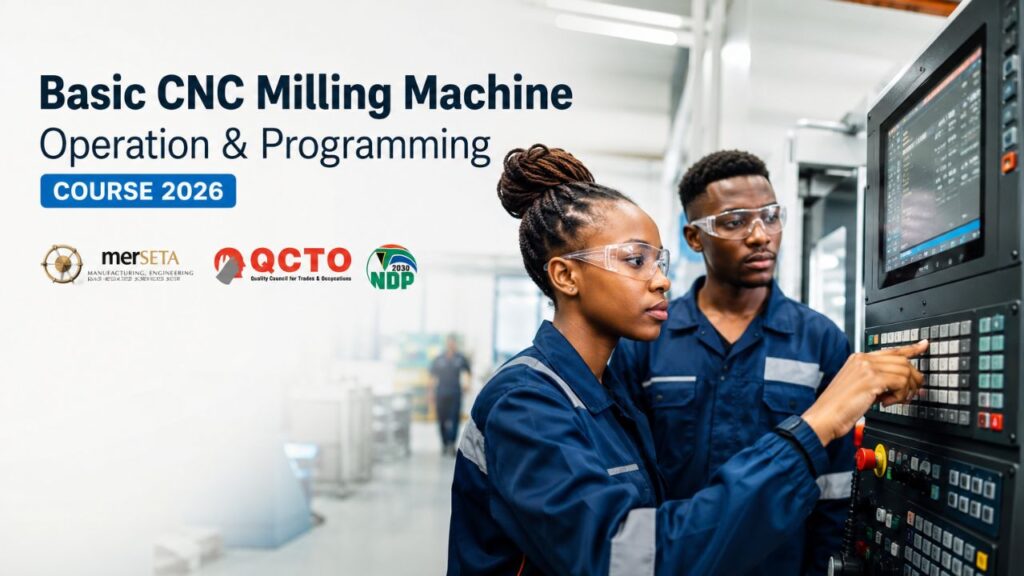
This intensive practical course places candidates directly in front of modern CNC milling centres. Participants learn how to read technical engineering drawings, convert measurements into logical numerical control commands, set up workholding devices securely, configure cutting tools, and execute precision machining procedures.
By removing the intimidation factor associated with sophisticated industrial automation, the programme builds confidence and technical competence. Graduates emerge fully capable of operating entry-level to mid-tier multi-axis CNC milling setups, monitoring tool wear, inspecting finished components against tight tolerances, and maintaining strict safety standards on factory floors.
Basic CNC Milling Machine Available Opportunities
Upon completing this practical skills module, graduates qualify for a wide variety of junior and intermediate technical positions across South Africa’s diverse industrial sectors. Key industries actively seeking these qualifications include automotive component manufacturing, aerospace tooling, structural steel fabrication, plastic injection mould production, and general precision engineering workshops.
Specific entry-level and transitional roles available to successful candidates include:
- Junior CNC Machine Operator: Responsible for setting up stock material, loading pre-written G-code programs, running production batches, and ensuring components meet dimensional standards.
- Trainee CNC Programmer: Focused on creating basic block code, writing linear and circular interpolation routines, and verifying program pathways before full production runs.
- Workshop Apprentice / Mechanical Assistant: Assisting senior toolmakers and machinists with workholding assembly, coolant management, machine cleaning, and basic tool offset calibrations.
- Quality Control Inspector (Machining): Utilizing precision measuring tools—such as digital vernier calipers, micrometers, and height gauges—to evaluate parts machined on CNC equipment.
Basic CNC Milling Machine Minimum Requirements
To ensure that all candidates receive maximum value from the intensive practical sessions, specific baseline criteria must be met before enrollment.
Educational Requirements
Applicants should possess a foundational understanding of basic mathematics, spatial reasoning, and technical drawing concepts. Preferred educational qualifications include:
- A Grade 12 (Matric) Certificate with passes in Mathematical Literacy or Pure Mathematics and Technical Sciences / Physical Sciences; OR
- An NCV Level 3 or Level 4 Qualification in Engineering and Related Design (Mechanical); OR
- An N1–N3 National Certificate in Fitting and Turning, Motor Mechanics, or Machining; OR
- Demonstrated relevant workplace exposure in a mechanical workshop environment (subject to Recognition of Prior Learning evaluation).
Age Requirements
- Minimum Age: Applicants must be at least 18 years old at the commencement of the course due to occupational health and safety regulations governing heavy machinery operation.
- Maximum Age: There is no upper age limit. Young school-leavers, adult artisans seeking cross-skilling, and mid-career professionals are all welcome to apply.
Additional Requirements
Candidates must meet the following general operational and administrative conditions:
- Citizenship: Open to South African citizens, permanent residents, and foreign nationals possessing valid work or study permits.
- Physical Capability: Candidates must be physically capable of standing for extended periods in a workshop setting, handling metal stock materials, and wearing mandatory Personal Protective Equipment (PPE).
- Safety Gear: Trainees must supply their own industrial safety footwear (steel-toe boots) and suitable workwear (overalls/work suits). Eye protection and ear defenders will be specified upon enrollment.
- Language Proficiency: Sufficient command of written and spoken English to follow technical instructions, read programming codes, and adhere to emergency safety protocols.
Basic CNC Milling Machine Monthly Stipend and Benefits
While this standalone short course is a fee-for-service skills development module (priced at R3,500 / P3,500) rather than a funded bursary with a monthly stipend, the financial and career returns on investment are substantial.
       [ Career Advancement Pipeline ]

  +---------------------------------------+
  |  Basic CNC Milling Machine Short Course |
  +---------------------------------------+
                      |
                      v
  +---------------------------------------+
  | Entry-Level Machine Operator Role     |
  | (Industry Average: R8,000 - R14,000)  |
  +---------------------------------------+
                      |
                      v
  +---------------------------------------+
  | Advanced Multi-Axis Programmer / Tool |
  | (Industry Average: R18,000 - R35,000+)|
  +---------------------------------------+
Key Programme Benefits
- High-Value Practical Experience: Over 70% of the course duration is dedicated to direct, practical interaction with actual CNC machinery and simulator software.
- Recognized Certification: Participants who successfully complete both practical assessments and theoretical tests receive an industry-aligned Certificate of Competency.
- Accelerated Duration: Unlike multi-year qualifications, this targeted short course allows participants to gain usable industrial skills in as little as 10 days (full-time) or across five weekend blocks (part-time).
- Career Advancement Potential: Certified CNC operators earn starting salaries significantly higher than un-skilled factory workers, with market rates for qualified CNC machinists ranging from R8,000 to R14,000 per month at entry level, rising substantially with multi-axis programming expertise.
Why This Basic CNC Milling Machine Opportunity Matters for South African Youth
Youth unemployment remains one of South Africa’s most pressing socioeconomic challenges. A primary driver of this crisis is the “skills mismatch”—where job seekers lack the specific, technical capabilities required by modern, automated manufacturing industries.
  Traditional Job Seeker                CNC-Trained Applicant
  +-----------------------+             +-----------------------+
  | - General Theory      |             | - Practical G-Code    |
  | - Limited Machine Use |             | - Tool Offset Setup   |
  | - High Competition    |             | - High Industry Demand|
  +-----------------------+             +-----------------------+
             |                                     |
             v                                     v
    Extended Searching                    Immediate Value Add
Investing in specialized practical training breaks this cycle. The Basic CNC Milling Machine module gives young South Africans a tangible skill set that is immediately useful on a factory floor. Employers in industrial hubs—such as Ekurhuleni, Durban South, Port Elizabeth, and Cape Town’s industrial zones—frequently struggle to find reliable operators who understand tool compensation, axis movement, and coordinate system setup. By mastering these fundamentals, youth position themselves as valuable assets from day one, drastically reducing the time required for employer onboarding and boosting long-term career resilience.
Basic CNC Milling Machine Application Process
Applying for this specialized technical training is straightforward, but prospective candidates should complete their registration early due to limited machine bench capacity per session.
Documents Required
When submitting your application or registering at the training centre, prepare clear copies of the following:
- Certified copy of your South African Identity Document or valid Passport/Permit.
- Certified copy of your highest academic credential (Matric certificate, N-courses, or tertiary qualification).
- Updated Curriculum Vitae (CV) highlighting any practical workshop experience.
- Proof of residence (for administrative registration).
- Proof of payment or deposit allocation for the course fee (R3,500 / P3,500).
Important Dates
| Stream | Start Date | Completion Date | Application Deadline |
|---|---|---|---|
| Full-Time Track | 17 August 2026 | 28 August 2026 | 10 August 2026 |
| Part-Time Track | 22 September 2026 | 19 October 2026* | 15 September 2026 |
*Part-time sessions take place across five key dates: 22 Sept, 29 Sept, 5 Oct, 12 Oct, and 19 Oct 2026.
Step-by-Step Application Guide
  [Step 1] Select Schedule (Full-Time or Part-Time)
     │
     ▼
  [Step 2] Gather Certified Documents & Complete Form
     │
     ▼
  [Step 3] Submit Online via Registration Portal / Campus
     │
     ▼
  [Step 4] Secure Placement via Course Fee Payment
     │
     ▼
  [Step 5] Receive Induction Notice & Safety Gear Checklist
- Select Your Schedule: Decide whether the 10-day intensive full-time schedule (August) or the 5-weekend part-time schedule (September/October) best fits your availability.
- Complete the Registration Form: Access the online registration portal via the training provider’s official website or collect a physical form at the admissions office.
- Attach Documentation: Upload or attach clear, certified copies of your ID and academic records.
- Confirm Payment Details: Complete the registration fee payment process using the official reference number provided by the admissions desk.
- Receive Enrollment Confirmation: Once your payment and documentation are verified, you will receive an official induction letter detailing safety gear requirements, orientation times, and workshop rules.
Application Tips: Basic CNC Milling Machine
- Secure PPE Early: Do not wait for the first day of class to buy safety boots and work overalls; fitted PPE is required to enter the workshop floor on Day 1.
- Brush Up on Coordinate Geometry: Review basic X, Y, and Z Cartesian coordinate principles before the course starts to make learning G-code programming faster and easier.
- Double-Check Verification Stamps: Ensure all certified copies are clear and stamped by a Commissioner of Oaths within the last 3 to 6 months.
Common Mistakes Applicants Should Avoid
To ensure a smooth admission process and successful completion of the course, steer clear of these frequent pitfalls:
- Submitting Unreadable Scans: Blurred photos of documents taken on mobile phones often lead to registration delays. Use proper scanning applications or copy shops.
- Ignoring Schedule Commitments: The full-time course requires 100% attendance over 10 consecutive working days. Missing even one practical session can cause you to fall behind on machine time.
- Using Incorrect Banking References: When paying your tuition deposit, always use the specific reference number provided during pre-registration to ensure your payment is assigned correctly.
- Waiting Until the Final Day: Practical workshops have strict cap limits (often 10–15 students per machine cohort). Waiting until the closing deadline risks missing out due to capacity limits.
DISCOVER MORE:
- APPRENTICESHIP
- GRADUATE PROGRAMME 2026
- INTERNSHIP 2026
- Learnerships 2026
- Learning Program 2026
- ONLINE APPLICATION
- ONLINE COURSES
- PROGRAMME 2026
- SETA
- Training Programme
Final Thoughts
Gaining modern, specialized technical skills is one of the most effective ways to build a stable, rewarding career in South Africa’s evolving economy. The Basic CNC Milling Machine Operation & Programming course provides a practical, industry-aligned pathway to high-demand manufacturing opportunities. By dedicating yourself to mastering digital machining techniques, you set a strong foundation for long-term professional growth and economic independence.
Frequently Asked Questions (FAQs)
Who can apply for this Basic CNC Milling Machine course?
Anyone aged 18 or older with a basic technical aptitude, a Grade 12 or equivalent qualification, and a strong interest in mechanical engineering, manufacturing, or machine operation can apply.
What qualifications are required to enroll?
A Grade 12 Certificate (preferably with Mathematics or Technical Literacy) or an N1–N3 National Certificate in a mechanical field is recommended. Relevant workshop experience is also considered.
What documents are needed during registration?
You need a certified copy of your ID/Passport, certified copies of your highest academic certificates, an updated CV, proof of residence, and proof of course fee payment.
What is the age requirement for the Basic CNC Milling Machine programme?
Applicants must be at least 18 years old to operate heavy industrial machinery under South African safety regulations. There is no upper age limit.
Is previous Basic CNC Milling Machine experience required?
No, this is a basic introductory-to-intermediate course designed to teach G-code programming and machine operation from the ground up.
Is the Basic CNC Milling Machine programme paid, or does it offer a stipend?
This short-course programme is a self-funded or employer-sponsored training module priced at R3,500 (P3,500). It does not pay a monthly stipend to candidates during training.
How much is the course fee?
The course fee is R3,500 (P3,500 / regional equivalent), which covers workshop access, training materials, machine time, and certification evaluation.
Where will successful applicants attend practical classes?
Training takes place at the accredited technical facility in Gauteng, featuring fully equipped practical machine bays and computer simulation labs.
When is the closing date for applications?
Applications close on 10 August 2026 for the full-time August intake and on 15 September 2026 for the part-time September intake.
How are candidates notified of successful enrollment?
Shortlisted and registered applicants receive an official confirmation notice, induction package, and workshop schedule via email and SMS shortly after submitting their completed registration and payment.
What certification do I receive upon completion?
Candidates who pass both theoretical and practical assessments receive a recognized Certificate of Competency in Basic CNC Milling Machine Operation & Programming.
Before applying, make sure you:
- Update your CV.
- Ensure your contact details are correct.
- Upload clear certified documents if requested.
- Double-check your academic information.
- Apply well before the closing date.
- Keep copies of your application confirmation.
Submitting an incomplete application may reduce your chances of being shortlisted.
ONLINELEARNERSHIP Advice If you qualify for this opportunity, do not wait until the final day to apply. Municipal recruitment systems often experience heavy traffic close to the closing date, and last-minute technical problems could prevent your application from being submitted successfully.
Before applying, make sure your CV is updated, your academic records are ready, and your proof of residence is available. Even if you are still completing your qualification and only require workplace exposure to graduate, this programme could provide the practical experience you need to complete your studies and strengthen your future employment prospects.
Also continue applying for similar internships and Work-Integrated Learning opportunities instead of relying on a single application.
Disclaimer: While every effort has been made to ensure the accuracy of this information, applicants are encouraged to verify all details directly with the official recruiting institution or employer before submitting an application. We are not affiliated with the recruiting organization and do not process applications on its behalf.

OnlineLearnership.co.za Editorial Team is dedicated to helping South Africans discover genuine career opportunities and build successful futures. Our team researches, verifies, and publishes the latest learnerships, internships, apprenticeships, graduate programmes, bursaries, entry-level jobs, and career development resources from trusted employers, government departments, municipalities, SETAs, TVET colleges, universities, and private companies across South Africa.
Our mission is to make career information easy to access by providing accurate, up-to-date, and easy-to-understand content that empowers job seekers, stude